
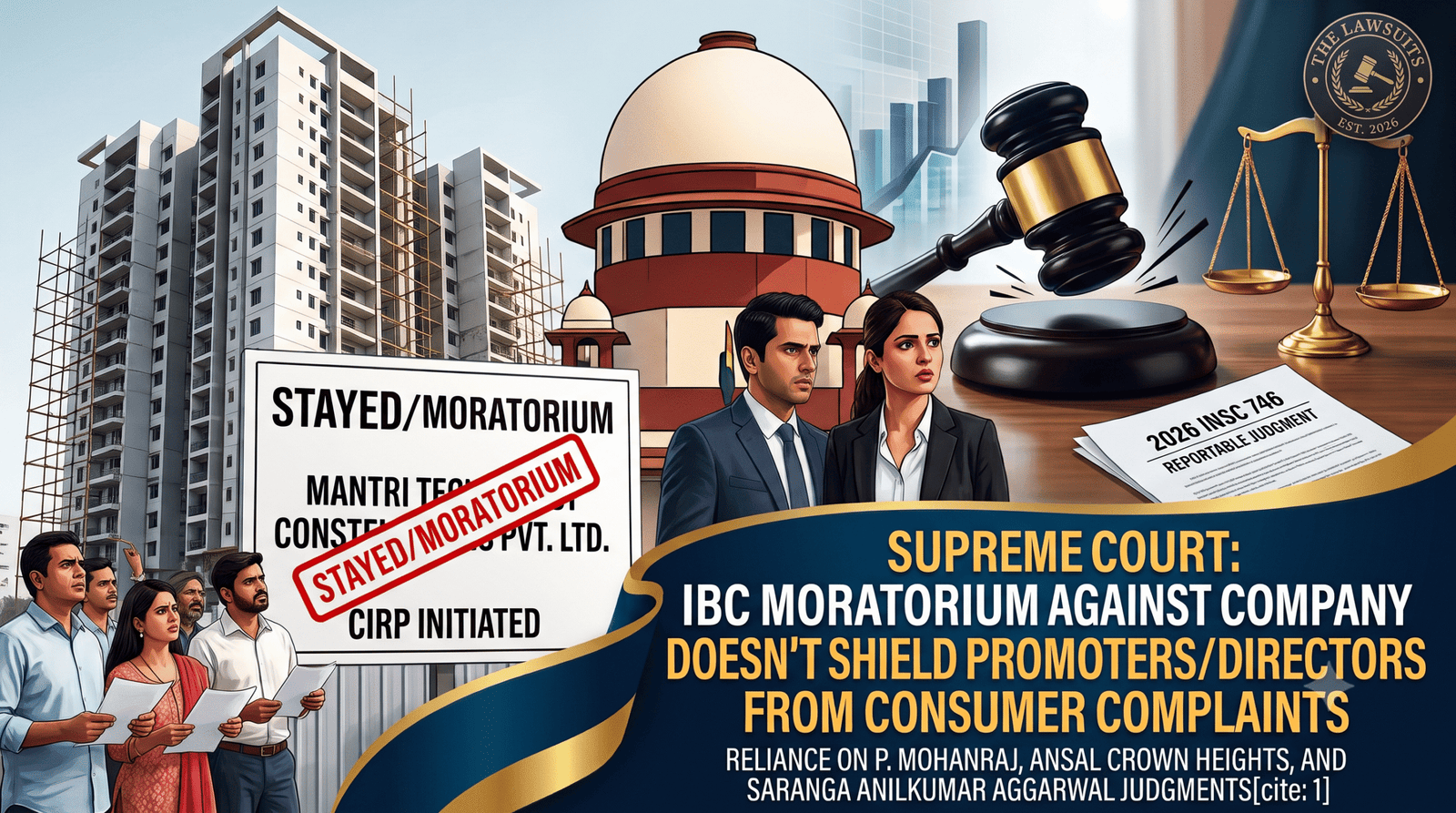
In a significant judgment benefiting homebuyers, the Supreme Court of India has held that the initiation of the Corporate Insolvency Resolution Process (CIRP) and the resulting statutory moratorium under Section 14 of the Insolvency and Bankruptcy Code, 2016 (IBC) against a real estate company cannot be used to halt or dismiss consumer proceedings against its promoters, directors, or associated entities.
A Division Bench comprising Justice Vikram Nath and Justice Sandeep Mehta set aside an order passed by the National Consumer Disputes Redressal Commission (NCDRC). The consumer forum had previously adjourned a flat buyer complaint sine die on the grounds that a moratorium was active against the primary developer firm.
Writing for the Bench, Justice Vikram Nath emphasized that the scope of a moratorium under the IBC is strictly statutory. The Court observed that neither an adjudicating authority nor a judicial body has the power to expand its scope beyond what the statute explicitly outlines. A plain reading of Section 14 makes it abundant clear that protection extends solely to the corporate debtor, leaving individual promoters and sister concerns exposed to independent statutory liabilities.
Background of the Dispute
The matter stems from a residential project in Bengaluru named ‘Mantri Manyata Energia’, developed by Respondent No. 1, Mantri Technology Constellations Private Limited (currently known as Buoyant Technology Constellations Private Limited). Homebuyers had entered into construction and sale agreements in 2016, with promised possession deadlines set for December 31, 2018.
Despite paying substantial portions of the sale consideration, the buyers were faced with persistent delays and unfulfilled promises. Aggrieved by the delay, the buyers jointly filed Consumer Case No. 13 of 2023 before the NCDRC, alleging severe deficiency in service and unfair trade practices. The complaint arrayed the principal developer alongside an associated company (Mantri Developers Private Limited), individual directors and promoters, as well as the original landowners.
During the pendency of the consumer case, the Bengaluru Bench of the National Company Law Tribunal (NCLT) admitted a Section 9 IBC application against the primary developer in August 2024, imposing a statutory moratorium under Section 14. In light of this development, the homebuyers moved interlocutory applications before the NCDRC, praying that while the proceedings against the primary developer remain stayed, the consumer complaint should continue against the remaining respondents.
However, by an order dated January 20, 2025, the NCDRC rejected the buyers’ applications. The Commission reasoned that the liability arising from the alleged deficiency in service was tied to agreements executed with the developer alone, and thus proceedings could not be split or independently adjudicated while CIRP was active. This refusal prompted the buyers to approach the Apex Court.
Supreme Court’s Analysis and Precedents
Examining the statutory framework, the Apex Court observed that the primary objective of Section 14 of the IBC is to preserve the assets of the corporate debtor to facilitate an orderly resolution process. However, this legal shield cannot be stretched beyond its statutory boundaries to protect natural persons, directors, or subsidiary firms.
To reinforce its ruling, the Bench relied on settled precedents:
In P. Mohanraj v. Shah Brothers Ispat Pvt. Ltd. (2021), the Supreme Court had clarified that the moratorium applies strictly to the corporate debtor company and does not grant immunity to natural persons involved in the operations.
Similarly, in Ansal Crown Heights Flat Buyers Association v. Ansal Crown Infrabuild Pvt. Ltd. (2024), the Court squarely held that an insolvency moratorium protecting a developer company does not offer a shield to its individual promoters or directors.
The Bench also cited Saranga Anilkumar Aggarwal v. Bhavesh Dhirajlal Sheth (2025), reaffirming that statutory protections under the insolvency framework must stay within their four walls and cannot be interpreted in a manner that stifles remedies guaranteed to consumers under consumer protection laws.
The Apex Court found fault with the NCDRC’s reasoning, noting that the Commission had effectively prejudged the merits of the case while deciding a mere procedural application. The Supreme Court pointed out that having acknowledged that the liability of the non-corporate debtor respondents was yet to be determined, the NCDRC could not simultaneously conclude that the deficiency was attributable only to the developer company to foreclose the inquiry at an interlocutory stage.
Final Verdict and Directions
While the homebuyers requested the Apex Court to adjudicate their consumer complaint directly, the Supreme Court declined to do so, observing that the respondents had raised several objections regarding privity of contract and maintainability that require initial determination by the forum of first instance.
Consequently, the Supreme Court partly allowed Civil Appeal Nos. 4289–4290 of 2025 and set aside the NCDRC order dated January 20, 2025. The Apex Court formally allowed Interlocutory Application Nos. 14200 of 2024 and 15656 of 2024, directing the NCDRC to resume and dispose of Consumer Complaint No. 13 of 2023 against Respondent Nos. 2 to 7 on its merits in accordance with law. The Court clarified that proceedings against the primary corporate debtor shall remain stayed subject to the IBC moratorium.
Case Summary Details
The judgment was delivered in Tejas J. Shah & Amisha T. Shah & Ors. v. Mantri Technology Constellations Pvt. Ltd. & Ors. (Civil Appeal Nos. 4289–4290 of 2025 / 2026 INSC 746) on July 27, 2026. The appellants were represented by their legal counsel, while Senior Advocates D. Seshadri Naidu, Sajan Poovayya, Shekhar G. Devasa, and Advocate Ashutosh Dubey appeared for the various respondents.
Concluding Note & Public Interest Disclaimer
This article has been published by The Law Suits solely in the interest of public awareness, legal literacy, and academic discussion regarding recent judicial pronouncements. It does not constitute legal advice, nor does it create an attorney-client relationship. Readers seeking specific legal remedies or assistance regarding housing disputes, real estate issues, or insolvency matters are advised to consult qualified legal counsel.
The Law Suits
413, Golden Chambers, Opp. Tanishq Showroom,
Near Lower Oshiwara Metro Station, Landmark CitiMall,
New Link Road, Andheri West, Mumbai – 400053
📞 Contact: +91-8928372392
📧 Email: bhimani@thelawsuits.in | adv.bhimani@gmail.com
🌐 Website: www.thelawsuits.in