
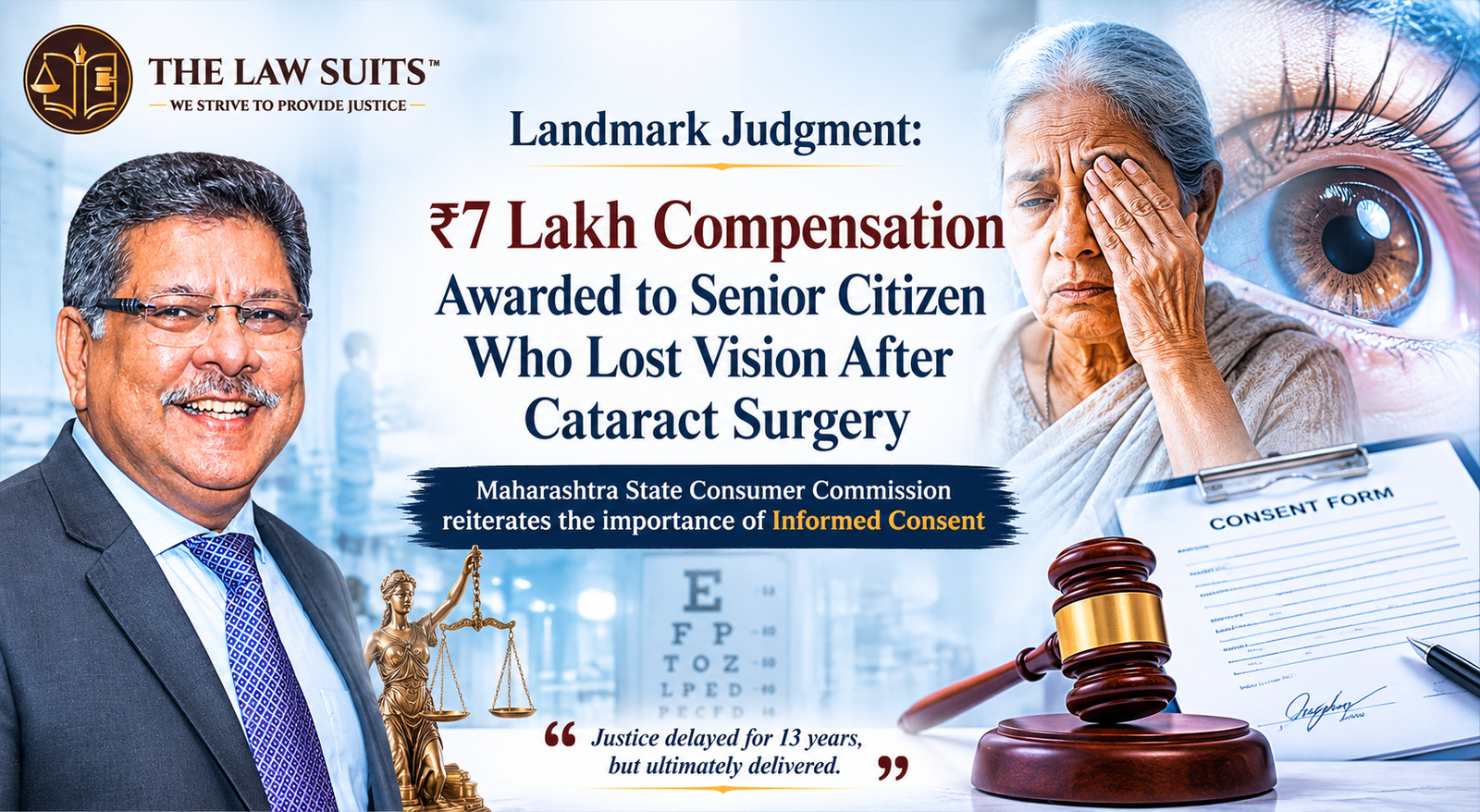
Maharashtra State Consumer Commission Awards ₹7 Lakh Compensation To Senior Citizen Who Lost Vision After Cataract Surgery After 13-Year Legal Battle
In a landmark medical negligence ruling, the Maharashtra State Consumer Commission awarded ₹7 lakh compensation to a senior citizen who lost vision in one eye after cataract surgery. Read the full case analysis, legal findings on informed consent, and implications for patient rights.
A significant judgment delivered by the Maharashtra State Consumer Disputes Redressal Commission, Mumbai, has once again highlighted the critical importance of informed consent in medical treatment and the legal accountability of healthcare professionals towards patients.
In a case that spanned more than thirteen years, the State Commission partly allowed a consumer complaint filed by senior citizen Smt. Rajani Prakash Malik against ophthalmic surgeon Dr. Ashok T. Bhole after she permanently lost vision in one eye following a cataract surgery performed in 2011.
The Commission awarded compensation of ₹7 lakh along with ₹50,000 towards litigation costs after holding the doctor liable for deficiency in service due to failure to obtain proper and valid informed consent from the patient before the surgery.
The judgment, delivered by Hon’ble Presiding Member Mr. Mukesh V. Sharma and Hon’ble Member Ms. Poonam V. Maharshi on March 13, 2026, is being viewed as an important precedent reinforcing patient autonomy and the doctrine of informed consent in medical jurisprudence.
According to the complaint, the patient had approached the doctor for treatment of a vision-related ailment and was advised to undergo cataract surgery after being assured that the procedure was simple, routine, and carried a high success rate. Trusting the assurances of the surgeon, she agreed to undergo the operation.
However, the complainant alleged that prior to the surgery, her signature was merely obtained on a pre-printed consent form without any meaningful explanation regarding the nature of the surgery, foreseeable complications, available alternatives, or the risk of permanent loss of vision.
Following the surgery, the patient reportedly developed severe pain, redness, watering, and progressive deterioration of vision in the operated eye. Despite repeated complaints, the doctor allegedly continued conservative treatment without timely referral to a higher medical centre. Eventually, the complainant underwent further treatment and surgery at another hospital, but her vision could not be restored permanently.
During the proceedings, the Commission examined whether the doctor had fulfilled his legal obligation of obtaining “real and informed consent” as recognised under Indian medical law. Referring extensively to the landmark Supreme Court judgment in Samira Kohli v. Dr. Prabha Manchanda and subsequent decisions of the National Consumer Disputes Redressal Commission, the State Commission reiterated that a patient must be informed about the nature of the procedure, foreseeable risks, complications, and alternative treatment options before consenting to surgery.
The Commission found the consent form relied upon by the doctor to be grossly inadequate. The form was merely a pre-printed document containing the patient’s signature without recording any disclosure of material risks, including the possibility of permanent loss of vision or loss of the eye itself.
In one of the most significant observations in the judgment, the Commission held that obtaining a bare signature on a printed form cannot be treated as lawful informed consent in the eyes of law.
The Commission observed that had the complainant been informed that the surgery carried a risk of permanent blindness or loss of the eye, she may have reconsidered undergoing the procedure or sought a second medical opinion.
At the same time, the State Commission drew a distinction between deficiency in obtaining informed consent and proof of medical negligence in the actual surgery. While the complainant succeeded on the issue of informed consent, the Commission held that no independent expert medical evidence had been produced to conclusively establish negligence in the surgical procedure or post-operative management itself.
Relying upon the principles laid down by the Supreme Court in Jacob Mathew v. State of Punjab, Kusum Sharma v. Batra Hospital, and other leading judgments, the Commission reiterated that an adverse medical outcome alone cannot automatically amount to medical negligence unless supported by cogent expert evidence demonstrating deviation from accepted medical standards.
Nevertheless, considering the irreversible loss suffered by the complainant, including permanent loss of vision, physical pain, emotional trauma, medical expenses, and disruption of normal life, the Commission concluded that compensation of ₹7 lakh would meet the ends of justice.
The matter was successfully argued on behalf of the complainant by Adv. Sulaiman Bhimani of The Law Suits, along with Adv. Sharon Fernandez and Adv. Alfiya Shaikh.
The judgment has already attracted significant attention in legal and mainstream media circles and has been reported by:
🔗 Free Press Journal
https://freepressjournal.in/mumbai/maharashtra-consumer-commission-awards-7-lakh-to-dombivli-woman-who-lost-vision-after-cataract-surgery
This ruling serves as a powerful reminder that patient consent is not a mere procedural formality but a substantive legal and ethical obligation. In an era where consumer rights and medical accountability are increasingly under judicial scrutiny, the judgment reinforces that transparency and patient awareness remain central pillars of responsible healthcare practice.
This article is posted in public interest and awareness by Adv. Sulaiman Bhimani, Founder of The Law Suits and President of Citizens Justice Forum (NGO).
📍 The Law Suits
413, Golden Chambers, Opp. Tanishq Showroom & CitiMall,
New Andheri Link Road, Andheri West, Mumbai – 400053
📞 Contact: +91 8928372392
📧 Email: adv.bhimani@gmail.com
🌐 Website: www.thelawsuits.in
Copy of Order