
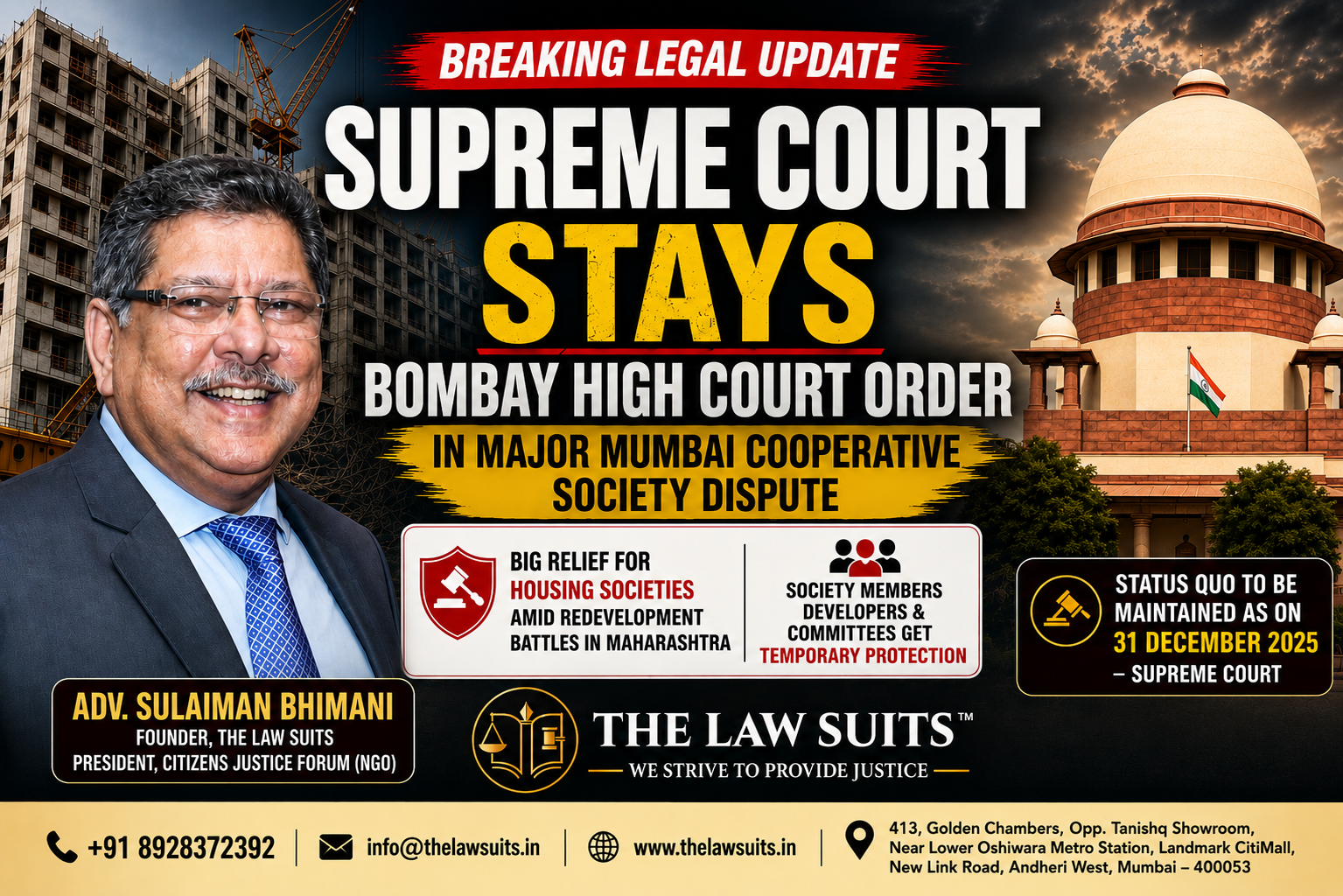
In a significant development impacting Cooperative Housing Societies across Maharashtra, particularly in Mumbai, the Hon’ble Supreme Court of India has stayed the operation of a landmark Bombay High Court judgment delivered by Justice Amit Borkar in the matter of Suresh Agarwal & Ors. vs. Sudhir Agarwal & Ors. The dispute revolves around the constitutional validity of a managing committee after multiple resignations reduced the committee strength below the statutory threshold prescribed under the Maharashtra Cooperative Societies Act, 1960.
The Supreme Court, while issuing notice in the Special Leave Petition, directed the parties to maintain status quo as prevailing on 31 December 2025, thereby effectively putting the Bombay High Court ruling into suspension for the time being.
This order has triggered widespread discussion among housing society members, redevelopment consultants, managing committees, cooperative law practitioners, and flat purchasers in Mumbai because thousands of societies in Maharashtra function with casual vacancies, resignations, co-option disputes, and internal political battles.
Also read MahaRERA Orders Builder to Hand Over Possession in 60 Days, Pay Interest for Delay in Malad East Project | The Law Suits Secures Relief for Homebuyer
Why This Judgment Is Creating Massive Discussion in Mumbai Housing Societies
Mumbai’s redevelopment ecosystem is deeply dependent on the functioning of managing committees. In many societies, committee resignations, factional disputes, allegations of manipulation, and attempts to stall redevelopment are common. The Bombay High Court judgment had created serious concerns because it laid down an extremely strict interpretation of Section 154B-19 of the Maharashtra Cooperative Societies Act.
The High Court held that if the number of elected committee members falls below “more than two-third” of the sanctioned strength at any point during the tenure, the committee ceases to remain legally constituted.
In simple words — “Committee toot gayi toh power khatam.” This interpretation, if implemented universally, could have destabilized hundreds of societies where resignations occur during redevelopment conflicts.
Background of the Dispute
The dispute arose in relation to Splendor Complex CHS Limited situated at Jogeshwari (East), Mumbai. The society had a sanctioned managing committee strength of 19 members. However, after several resignations, the committee strength allegedly reduced substantially.
The contesting member argued that once the elected strength fell below 13 members — which is more than two-third of 19 — the committee lost its legal authority to function. According to the challenge, such a weakened committee could not continue passing resolutions, conducting meetings, or initiating co-option procedures.
On the other hand, the managing committee argued that the committee was validly constituted on the date of election itself and later vacancies would not invalidate the committee. They further argued that quorum and constitution are separate legal concepts.
Also read on Hindustan Times: Time restrictions on filing insurance claims are void: HC
What the Bombay High Court Held
Justice Amit Borkar delivered an elaborate judgment interpreting Sections 154B-19, 154B-22, and Rule 74 of the Maharashtra Cooperative Societies Election Rules.
The High Court held that:
- The constitution of a managing committee is a continuous requirement and not merely a one-time event occurring on the date of election.
- The committee must continuously maintain “more than two-third” elected strength during its tenure.
- If elected strength falls below the statutory threshold, the committee automatically loses legal validity.
- Co-option cannot be used to revive a committee that has already lost constitutional strength.
- Reserved vacant seats can be ignored only for quorum purposes and not for determining constitutional validity.
The Court further observed that the law does not permit a small minority group to continue controlling the affairs of a cooperative society after losing democratic majority support.
The High Court ultimately dismissed the writ petitions and upheld the restraint against the committee from conducting meetings or passing resolutions.
Also read Unregistered Family Settlement vs. Registered Gift Deeds: A Landmark Mumbai Arbitral Award
The Supreme Court’s Intervention Changes the Entire Landscape
The matter was immediately challenged before the Hon’ble Supreme Court of India through Special Leave Petitions.
A Bench comprising J.B. Pardiwala and K.V. Viswanathan heard the matter on 5 January 2026.
The Supreme Court issued notice and directed all parties to maintain status quo prevailing as on 31 December 2025.
Though the order is interim in nature, its practical impact is enormous because it prevents immediate implementation of the Bombay High Court ruling and temporarily protects societies from sudden administrative paralysis.
Why the Supreme Court Stay Is Important for Redevelopment Projects
Across Mumbai and Maharashtra, redevelopment projects frequently witness:
- Political rivalry within societies
- Mass resignations by committee members
- Allegations of coercion
- Committee instability
- Litigation filed to stop redevelopment
- Challenges to co-option procedures
- Registrar intervention under Sections 77A and 78
If the Bombay High Court judgment had remained operational without interruption, many redevelopment committees would have faced immediate challenges regarding their legal existence.
Developers, banks, project consultants, architects, and purchasers would also have faced uncertainty regarding resolutions passed by such committees.
The Supreme Court’s interim protection has therefore provided temporary relief and administrative breathing space.
The Larger Legal Question Before the Supreme Court
The Supreme Court will now likely decide a very important question affecting Cooperative Housing Societies throughout Maharashtra:
Does a managing committee remain valid after subsequent resignations reduce its elected strength below two-third?
The answer to this question will have statewide consequences.
If the Supreme Court upholds the Bombay High Court view, many societies may require fresh elections whenever committee strength falls below the statutory threshold.
If the Supreme Court reverses the High Court entirely, committees may continue functioning despite later resignations, provided quorum requirements are maintained.
This will directly affect redevelopment approvals, conveyance decisions, appointment of developers, bank permissions, litigation authority, and execution of redevelopment agreements.
Impact on Society Members and Flat Purchasers
For ordinary flat purchasers and society members, this litigation highlights one important reality:
“Society politics can directly affect redevelopment, property value, and legal rights.”
Many members assume internal committee disputes are minor issues. However, committee validity affects:
- Redevelopment resolutions
- Appointment of developers
- Execution of Development Agreements
- Permanent Alternate Accommodation Agreements (PAAA)
- Corpus approvals
- Tender processes
- Litigation authority
- Society bank operations
A single legal defect in committee constitution can delay projects for years.
Legal Experts Say the Final Verdict Will Become a Landmark Precedent
Cooperative law practitioners believe the final Supreme Court ruling may become one of the most important judgments on Maharashtra Cooperative Housing Society governance in recent years.
The interpretation of Sections 154B-19 and 154B-22 may permanently define:
- What constitutes a valid committee;
- Whether democratic majority must continue throughout tenure;
- How co-option powers can be exercised;
- When Registrar intervention becomes mandatory.
The ruling may also affect ongoing disputes before:
- Cooperative Courts
- Cooperative Appellate Courts
- Deputy Registrars
- Divisional Joint Registrars
- Bombay High Court
- MahaRERA-linked redevelopment disputes
Final Observation
The dispute between the rival factions of Splendor Complex CHS Limited has now evolved into a much larger legal battle concerning the future governance of Cooperative Housing Societies in Maharashtra.
While the Bombay High Court adopted a strict democratic interpretation requiring continuous maintenance of elected strength, the Supreme Court’s interim stay indicates that the issue requires deeper examination at the highest judicial level.
For now, housing societies, redevelopment committees, and flat purchasers across Mumbai will closely watch the final outcome because the eventual judgment may redefine the legal framework governing cooperative society administration in Maharashtra.
This article is posted in public interest and awareness by Adv. Sulaiman Bhimani, Founder of The Law Suits and President of Citizens Justice Forum (NGO).
The Law Suits
413, Golden Chambers, Opp. Tanishq Showroom,
Near Lower Oshiwara Metro Station,
Landmark CitiMall, New Link Road,
Andheri West, Mumbai – 400053
📞 Contact: +91-9323642089
📧 Email: info@thelawsuits.in
🌐 www.thelawsuits.in