
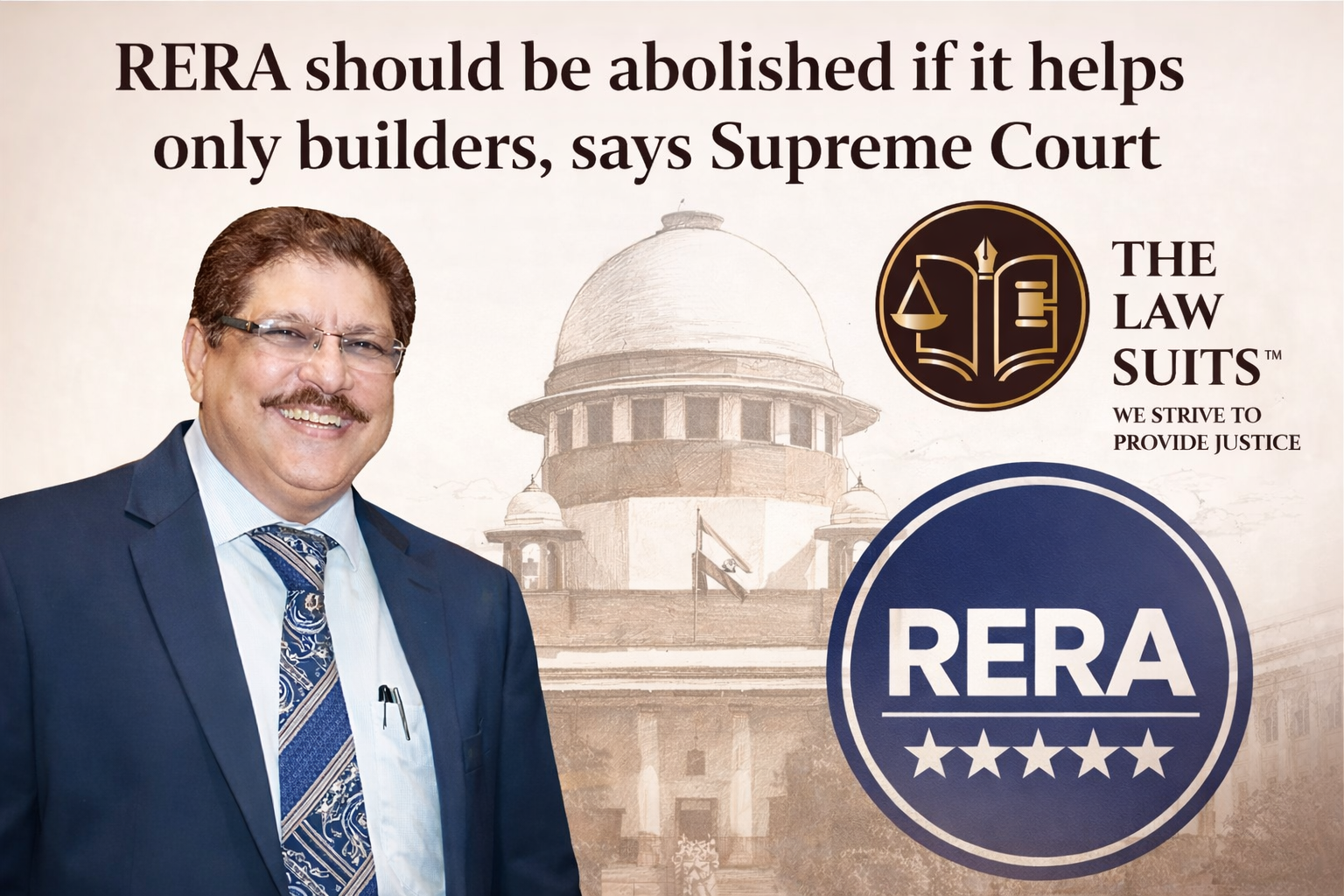
“Better Abolish RERA If It Only Helps Defaulting Builders”: Supreme Court’s Strong Warning Raises Serious Questions on Real Estate Regulation
In a rare and scathing observation, the Supreme Court of India has openly questioned the relevance and functioning of the Real Estate Regulatory Authority (RERA), stating that if the authority exists only to facilitate defaulting builders, “it is better to abolish such an institution.”
The remarks, reported by Press Trust of India (PTI) and published by The Economic Times, have triggered nationwide debate on whether RERA has failed to fulfil its core objective of protecting homebuyers.
Also Read MahaRERA Orders Recovery Warrant After 8-Year RERA Legal Battle
Supreme Court Slams RERA for Protecting Builders Instead of Homebuyers
During a hearing on Thursday, the Supreme Court expressed deep dissatisfaction with the functioning of RERA authorities across states. The Bench observed that homebuyers are frustrated, disappointed, and left without effective remedies, while defaulting builders continue to enjoy procedural leniency.
“Except facilitating builders in default, this institution is doing nothing. We don’t mind if it is abolished,”
— Supreme Court of India (oral observations)
Such remarks from the apex court underline a serious institutional failure in the implementation of the Real Estate (Regulation and Development) Act, 2016.
Background of the Case: Why the Supreme Court Made These Remarks
The observations were made while hearing a petition filed by the State of Himachal Pradesh, challenging a High Court order that stayed the relocation of the Himachal Pradesh RERA office from Shimla to Dharamshala.
Although the case was administrative in nature, the Supreme Court took the opportunity to comment on the larger systemic problems affecting RERA authorities nationwide.
Why the Supreme Court’s Observation on RERA Is Significant
RERA Was Enacted to Protect Homebuyers
The RERA Act was introduced with the promise of:
-
- Timely delivery of real estate projects
-
- Transparency in builder dealings
-
- Protection against fund diversion
-
- Speedy dispute resolution
However, the Supreme Court’s remarks suggest that these objectives are not being achieved in practice.
Regulatory Capture by Builders?
The Court’s statement that RERA is “facilitating defaulting builders” raises concerns of:
-
- Weak enforcement of RERA orders
-
- Failure to penalise non-compliant developers
-
- Delays in execution of refund and possession orders
This has resulted in thousands of homebuyers being forced to approach consumer courts, High Courts, and even the Supreme Court for relief.
Is the Supreme Court Abolishing RERA?
No. It is important to clarify that RERA has not been abolished. The Supreme Court’s remarks are oral observations, not a binding judicial direction.
However, such strong words from the apex court serve as a constitutional warning to:
-
- State Governments
-
- RERA Authorities
-
- Policy makers
that urgent structural reforms are required.
RERA’s Ground Reality: A Toothless Regulator?
Despite thousands of orders passed in favour of homebuyers:
-
- Recovery warrants remain unexecuted
-
- Builders continue launching new projects
-
- Insolvent developers escape accountability
-
- RERA authorities lack coercive enforcement
This has led to RERA being increasingly described as a “toothless tiger”, forcing buyers to rely on:
-
- Consumer Protection Act remedies
-
- Insolvency proceedings under IBC
-
- Writ petitions before High Courts
What the Supreme Court’s Remarks Mean for Homebuyers
The Supreme Court’s observations can be strategically used by homebuyers and housing societies to:
-
- Challenge arbitrary RERA inaction
-
- Seek strict enforcement of RERA orders
-
- Argue regulatory failure before constitutional courts
-
- Push for stronger remedies against defaulting builders
These remarks may also influence pending RERA appeals, writ petitions, and consumer complaints across India.
Need for Urgent RERA Reforms
The Supreme Court has effectively signalled that:
-
- RERA authorities must be made independent and accountable
-
- Enforcement mechanisms need real teeth
-
- Homebuyer confidence must be restored
-
- Builders should not be allowed to misuse regulatory delays
Without reform, RERA risks losing its legitimacy as a consumer-protection law.
Conclusion: A Wake-Up Call for the Real Estate Regulatory System
The Supreme Court’s sharp criticism of RERA reflects a deep erosion of trust between homebuyers and regulatory institutions. What was envisioned as a revolutionary reform in real estate governance now faces existential questions.
Unless RERA is restructured, empowered, and strictly enforced, it may continue to fail the very citizens it was meant to protect.
The message from the Supreme Court is clear:
Regulation without enforcement is no regulation at all.
The Law Suits,
413, Golden Chambers, Opp Tanishq Showroom,
Next to Lower Oshiwara Metro Station, LandMark CitiMall,
Andheri Link Road, Andheri West Mumbai 400053 +91 8928 372392
adv.Bhimani@gmail.com