
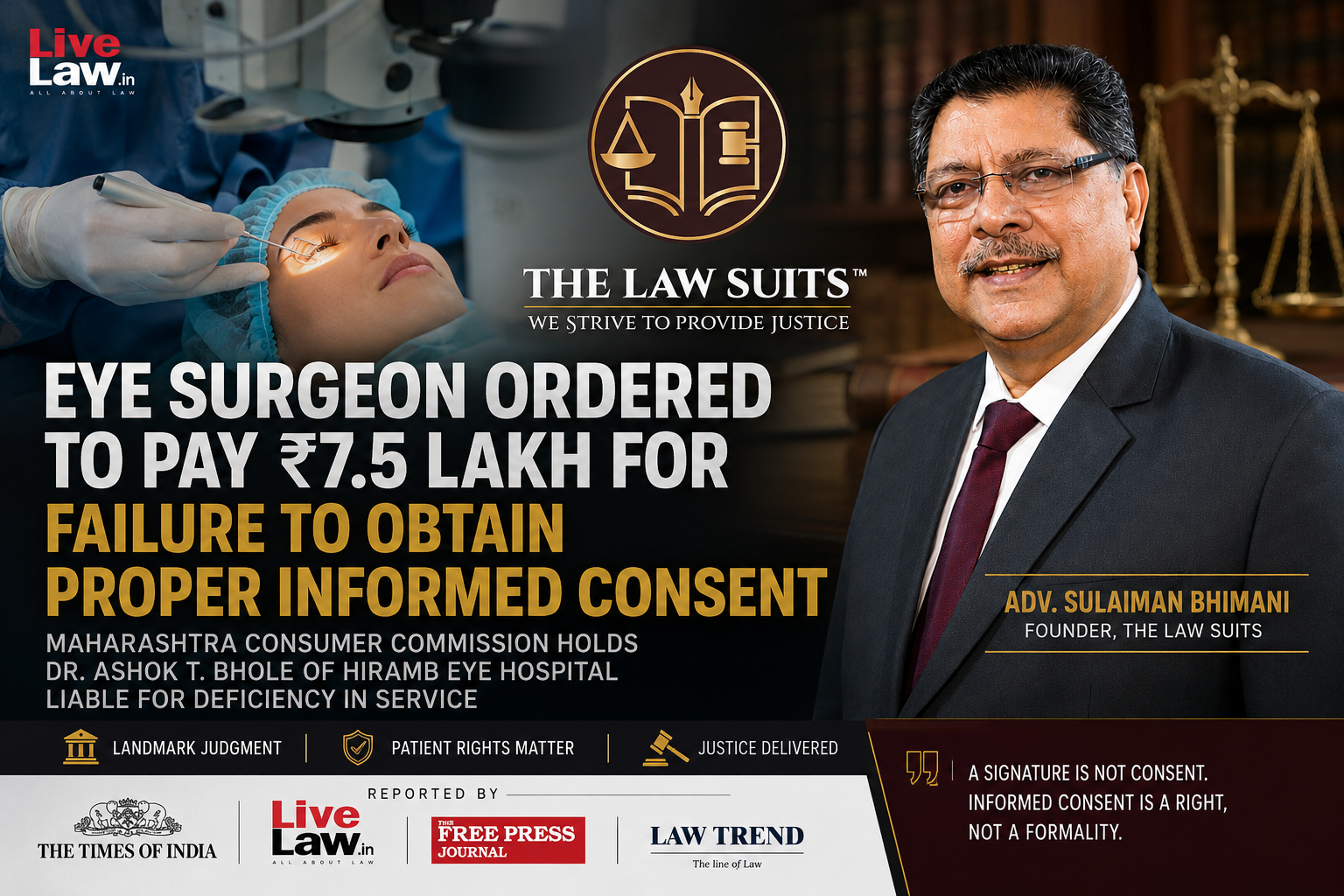
Eye Surgeon Ordered to Pay ₹7.5 Lakh for Failure to Obtain Proper Informed Consent: A Landmark Reminder of Patients’ Rights
Reported by Times of India, LiveLaw, Free Press Journal and Law Trend, the ruling highlights why informed consent is no mere formality under Indian medical negligence law.
A significant judgment of the Maharashtra State Consumer Disputes Redressal Commission has once again brought the spotlight on one of the most fundamental rights of every patient—the right to informed consent before undergoing medical treatment.
The decision, which has attracted widespread attention after being reported by The Times of India, LiveLaw, Free Press Journal and Law Trend, arose from a complaint filed by Dombivli resident Mrs. Rajani Malik, who permanently lost vision in her operated eye following cataract surgery. The Commission ultimately awarded compensation of approximately ₹7.5 lakh and held that the treating surgeon had failed to obtain proper and legally valid informed consent before performing the procedure.
The case involved ophthalmic surgeon Dr. Ashok T. Bhole of Hiramb Eye Hospital. According to the findings recorded by the Maharashtra State Consumer Commission and subsequently reported by leading legal and mainstream media publications, the consent form relied upon by the doctor was merely a pre-printed document bearing the patient’s signature. It did not adequately disclose the nature of the surgery, the attendant risks, possible complications, available alternatives, or the potential consequences that could arise from the procedure.
The ruling has generated considerable discussion among legal professionals, consumer rights advocates and healthcare practitioners because it reiterates a principle that is often overlooked in medical practice: obtaining a patient’s signature is not the same as obtaining informed consent.
As reported by LiveLaw, the Commission observed that a pre-printed consent form without disclosure of surgical risks cannot be regarded as valid informed consent. The Commission noted that there was no meaningful disclosure regarding the specific risks associated with the surgery, including the possibility of severe complications and loss of vision.
The Times of India reported that the Commission held the doctor liable for deficiency in service on account of the failure to obtain proper informed consent. The Commission further observed that if the complainant had been adequately informed about the possibility of permanent loss of vision or even loss of the eye itself, it could not automatically be presumed that she would have agreed to undergo the procedure.
The Free Press Journal, while reporting the judgment, highlighted that the complainant had lost vision following cataract surgery and was awarded compensation by the Consumer Commission. Law Trend similarly reported that the surgeon was held liable for failing to disclose specific risks in the consent process and that the Consumer Commission treated the omission as a serious deficiency in service.
The importance of this ruling extends far beyond the facts of a single case. It serves as a reminder that informed consent is not a routine administrative requirement but a legal and ethical obligation rooted in the patient’s right to autonomy and self-determination. Every patient has the right to understand the nature of the proposed treatment, the risks involved, the alternatives available and the possible consequences before deciding whether to proceed.
Indian courts have consistently recognised that a patient cannot be expected to make an informed decision without being provided adequate information. A signed document may establish that a signature was obtained; it does not necessarily establish that the patient understood the treatment, appreciated the risks or knowingly accepted the consequences.
The Rajani Malik judgment also reflects a broader trend in medical negligence litigation across India. Consumer Commissions are increasingly examining not only the technical aspects of medical treatment but also the quality of communication between doctors and patients. In many disputes, the critical issue is no longer whether a complication occurred but whether the patient was adequately informed about the possibility of that complication before consenting to treatment.
The decision is therefore likely to be cited in future cases involving medical negligence, cataract surgery complications, informed consent, hospital liability, consumer protection and patient rights. It reinforces the legal position that healthcare providers must engage in meaningful communication with patients rather than rely solely upon standardised forms and paperwork.
For patients and their families, the case offers valuable lessons. Medical records, prescriptions, diagnostic reports, discharge summaries and consent forms should always be carefully preserved. These documents frequently become crucial evidence when disputes arise regarding treatment, accountability and compensation.
At the same time, it is important to recognise that not every adverse medical outcome amounts to negligence. Medicine is not an exact science, and complications may arise despite the exercise of reasonable skill and care. However, where material risks are not disclosed and informed consent is not properly obtained, liability may arise even if the procedure itself was technically performed with competence.
The widespread reporting of this judgment by leading legal and mainstream publications demonstrates the growing public importance of informed consent in healthcare. More importantly, it sends a clear message that patients are entitled to participate in decisions affecting their health and that medical practitioners must respect that right through full, fair and transparent disclosure.
The matter was successfully argued on behalf of the complainant by Adv. Sulaiman Bhimani, Founder of The Law Suits. Over the years, The Law Suits has represented numerous consumers, homebuyers and citizens before Consumer Commissions and various judicial forums. Several matters handled by the firm have received coverage in leading publications including LiveLaw, Hindustan Times, Free Press Journal, Mumbai Mirror and other national media platforms.
The Law Suits has developed a significant practice in consumer protection law, medical negligence litigation, real estate disputes, housing society matters and public interest causes. Through litigation, legal awareness programmes, webinars and public education initiatives, the firm has consistently worked towards strengthening consumer rights and access to justice.
Advocates practising in the field of consumer protection law regard judgments relating to informed consent as increasingly significant because they sit at the intersection of medical ethics, patient autonomy and consumer rights. As awareness grows and patients become better informed about their legal remedies, healthcare institutions may be required to revisit their consent procedures and documentation practices to ensure compliance with evolving legal standards.
The Rajani Malik judgment is ultimately about more than compensation. It is about recognising a patient’s right to make an informed choice. The decision reaffirms a simple but powerful legal principle that every hospital, doctor and patient should remember: a signature may indicate consent, but only knowledge and understanding can create informed consent.
About The Law Suits
The Law Suits is a Mumbai-based law firm founded by Adv. Sulaiman Bhimani. The firm regularly advises and represents clients in matters relating to consumer protection, medical negligence, real estate disputes, housing society litigation and public interest matters. Several landmark matters handled by the firm have contributed to consumer rights jurisprudence and have been reported by leading legal and mainstream publications.
If you or a family member have suffered due to suspected medical negligence, lack of informed consent, surgical complications, hospital negligence, deficiency in medical services, builder misconduct or consumer rights violations, understanding your legal rights at an early stage can be crucial. Timely legal advice may assist in evaluating the remedies available under consumer protection law and other applicable legal provisions.
Author: Adv. Sulaiman Bhimani
Founder, The Law Suits
The Law Suits
413, Golden Chambers, Opp. Tanishq Showroom,
Near Lower Oshiwara Metro Station, Landmark CitiMall,
New Link Road, Andheri West, Mumbai – 400053
Mobile: +91 89283 72392
Email: info@thelawsuits.in adv.bhimani@gmail.com
Website: www.thelawsuits.in
Sources
Times of India – Eye Surgeon to Pay Compensation for Failure to Obtain Proper Informed Consent, Eye surgeon to pay ₹7.5L for failing to get ‘informed consent’ before op https://epaper.indiatimes.com/arte-share?article=05_06_2026_005_013_toim_TOI
LIVE LAW: Maharashtra State Commission: Pre-Printed Consent Form Without Disclosure Of Surgical Risks Is Not Valid Infor… https://www.livelaw.in/consumer-cases/maharashtra-state-commission-pre-printed-consent-form-without-disclosure-of-surgical-risks-is-not-valid-informed-consent-doctor-liable-for-deficiency-in-service-536
Free Press Journal – Maharashtra Consumer Commission Awards ₹7 Lakh To Dombivli Woman Who Lost Vision After Cataract Surgery https://freepressjournal.in/mumbai/maharashtra-consumer-commission-awards-7-lakh-to-dombivli-woman-who-lost-vision-after-cataract-surgery
Law Trend – Ophthalmic Surgeon Liable for Failing to Disclose Specific Risks in Consent Form: Consumer Court Awards Rs 7 Lakh Compensation https://lawtrend.in/ophthalmic-surgeon-liable-for-failing-to-disclose-specific-risks-in-consent-form-consumer-court-awards-rs-7-lakh-compensation/