
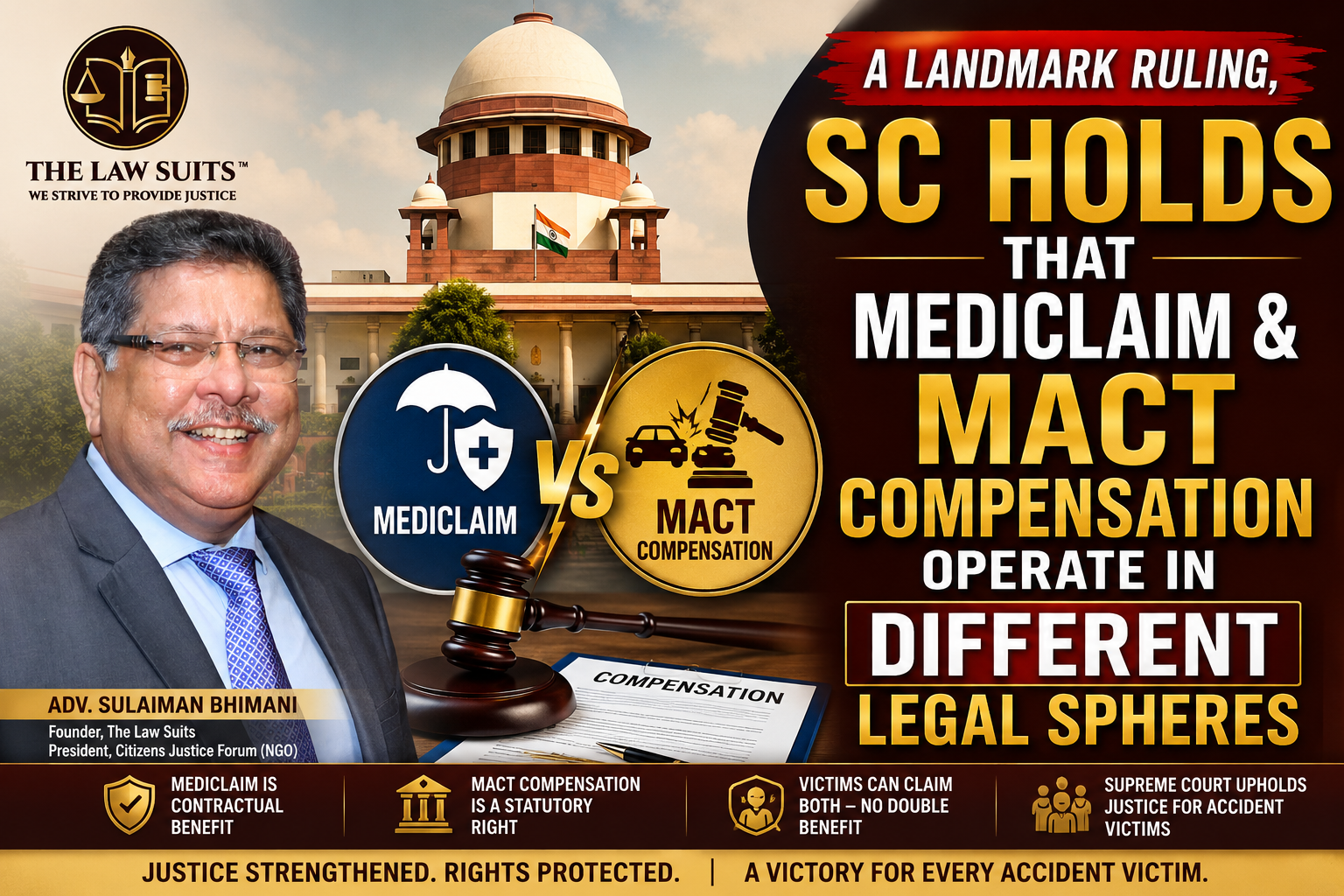
In a Landmark Ruling, Supreme Court Holds That Mediclaim and MACT Compensation Operate in Different Legal Spheres
In a significant judgment that will impact thousands of motor accident compensation cases across India, the Supreme Court of India has held that amounts received by accident victims under a Mediclaim or health insurance policy cannot be deducted from compensation awarded under the Motor Vehicles Act, 1988.
The ruling came in New India Assurance Company Limited v. Dolly Satish Gandhi & Anr., where the Apex Court settled a long-standing legal conflict among various High Courts on whether a claimant receiving reimbursement under a Mediclaim policy could again claim medical expenses before the Motor Accident Claims Tribunal (MACT).
The Supreme Court decisively answered in favour of accident victims.
Also read MahaRERA Orders Builder to Hand Over Possession in 60 Days, Pay Interest for Delay in Malad East Project | The Law Suits Secures Relief for Homebuyer
The Core Legal Question Before The Supreme Court
The Court examined whether reimbursement received under a Mediclaim policy amounts to “double compensation” if the same medical expenses are also claimed under a motor accident compensation proceeding.
Insurance companies argued that once medical expenses are reimbursed through Mediclaim, the claimant has already been compensated, and therefore awarding the same amount under MACT would amount to unjust enrichment.
However, the injured claimant argued that Mediclaim benefits arise from a private contractual arrangement for which premiums were paid over years, whereas compensation under the Motor Vehicles Act is a statutory remedy arising from negligence and wrongful acts.
Also read on Hindustan Times: Time restrictions on filing insurance claims are void: HC
Stand Taken by the Insurance Company
Supreme Court Draws A Clear Distinction Between “Statutory” And “Contractual” Rights
Justice Sanjay Karol, speaking for the Bench, undertook an extensive analysis of the difference between contractual insurance benefits and statutory compensation rights.
The Court explained that:
- A Mediclaim policy is purchased by an individual after paying premiums.
- It is a contractual entitlement arising out of a private insurance agreement.
- Compensation under the Motor Vehicles Act is a statutory right flowing from beneficial legislation intended to compensate accident victims.
The Supreme Court held that both remedies operate independently and cannot cancel each other out.
The Court observed:
“The contractual benefit of reimbursement of medical expenses as a result of this policy is, therefore, independent of any other claim.”
Read also Even ‘Loan’ Can Qualify As ‘Deposit’ Under MPID Act; Private Individual Can Be ‘Financial Establishment’ : Supreme Court
Why The “Double Benefit” Argument Was Rejected
One of the strongest arguments advanced by insurers was that permitting both Mediclaim reimbursement and MACT compensation would amount to “double benefit.”
The Supreme Court rejected this contention and held that such a view would unfairly penalize prudent citizens who had paid health insurance premiums for years.
The Court made an important observation:
- If Mediclaim reimbursement is deducted, the offending vehicle’s insurer gets an unfair advantage.
- Simultaneously, the Mediclaim insurer retains the premium but escapes liability.
- Such an interpretation would defeat the purpose of health insurance itself.
The Bench further emphasized that Mediclaim policies are purchased to deal with uncertainties of life and rising medical costs and are not exclusively tied to motor accidents.
Supreme Court Relied On Earlier Landmark Judgments
The Court analyzed several important precedents, including:
- Helen C. Rebello v. Maharashtra SRTC
- United India Insurance Co. Ltd. v. Patricia Jean Mahajan
- Reliance General Insurance Co. Ltd. v. Shashi Sharma
- Sebastiani Lakra v. National Insurance Co. Ltd.
The Court reaffirmed the principle laid down in Helen Rebello that amounts received independently through savings, insurance, provident fund, pension, or contractual benefits cannot ordinarily be deducted from compensation payable under motor accident law.
Supreme Court Criticizes Conflicting High Court Judgments
One of the most notable aspects of the judgment is the Supreme Court’s strong remarks on judicial inconsistency.
The Court observed that various High Courts — and in some cases even different Benches of the same High Court — had taken contradictory views on the same legal issue.
The judgment contains detailed comparative tables showing conflicting rulings from:
- Bombay High Court
- Delhi High Court
- Kerala High Court
- Punjab & Haryana High Court
- Madhya Pradesh High Court
The Supreme Court warned that such inconsistency creates uncertainty in the justice delivery system and affects judicial efficiency.
The Court also reminded both lawyers and judges of their duty to ensure consistency in legal precedents and avoid conflicting interpretations.
Final Verdict Of The Supreme Court
The Supreme Court conclusively held:
“The amount received as part of Mediclaim/medical insurance is not deductible from compensation as calculated by the concerned Tribunal.”
The Court clarified that:
- Mediclaim reimbursement is contractual.
- MACT compensation is statutory and beneficial in nature.
- Both stand on different legal footings.
- Accident victims are entitled to both remedies simultaneously.
Why This Judgment Is Important
This ruling is likely to have far-reaching implications in motor accident claims across India because:
1. Protects Rights Of Accident Victims
Victims will no longer be deprived of full compensation merely because they acted prudently by purchasing health insurance.
2. Strengthens Beneficial Interpretation Of MV Act
The judgment reinforces that the Motor Vehicles Act must be interpreted in favour of victims and not insurers.
3. Resolves Nationwide Legal Confusion
The Supreme Court has now settled conflicting legal positions that existed across various High Courts for years.
4. Major Financial Impact On Insurance Litigation
Insurance companies may now face higher liabilities in MACT matters where Mediclaim reimbursements were earlier sought to be deducted.
Legal Significance For MACT And Insurance Litigation
This judgment will become a leading precedent in:
- Motor accident compensation claims
- Insurance disputes
- MACT litigation
- Personal injury compensation jurisprudence
- Interpretation of beneficial legislation
Lawyers handling MACT matters must now carefully rely upon this judgment while opposing deductions sought by insurance companies on account of Mediclaim reimbursements.
Conclusion
The Supreme Court has reaffirmed a crucial principle of justice — a victim should not be penalized for being financially responsible and purchasing health insurance.
By recognizing the independent nature of Mediclaim benefits and statutory motor accident compensation, the Court has protected the rights of accident victims while reinforcing the beneficial object of the Motor Vehicles Act.
This judgment is expected to become a landmark authority in motor accident compensation law and will significantly influence future MACT litigation across India.
This article is posted in public interest and awareness by Adv. Sulaiman Bhimani, Founder of The Law Suits and President of Citizens Justice Forum (NGO).
The Law Suits
413, Golden Chambers, Opp. Tanishq Showroom,
Near Lower Oshiwara Metro Station,
Landmark CitiMall, New Link Road,
Andheri West, Mumbai – 400053
📞 Contact: + 91 8928372392
📧 Email: bhimani@thelawsuits.in Adv.bhimani@gmail.con
🌐 Website: The Law Suits