
Introduction: A Crucial Clarification in IBC Limitation Law
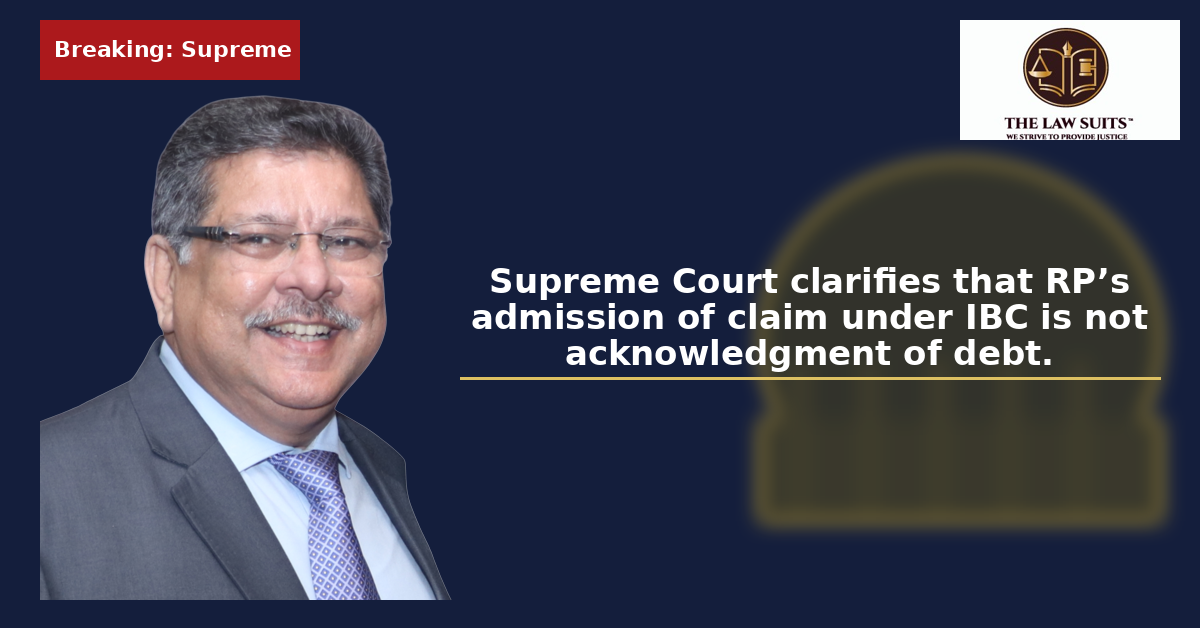
In a landmark ruling under the Insolvency and Bankruptcy Code, 2016, the Supreme Court of India has decisively clarified that admission of a claim by a Resolution Professional (RP) during
CIRP does not amount to acknowledgment of debt under Section 18 of the Limitation Act, 1963.
This judgment addresses a recurring legal issue that has frequently surfaced before the National Company Law Tribunal and the National Company Law Appellate Tribunal, especially in cases where creditors attempt to extend limitation through insolvency proceedings.
Case Overview: Shankar Khandelwal vs Omkara ARC
The dispute originated from loan facilities extended in 2014, which were classified as Non-Performing Assets (NPA) on 6 December 2016. The financial creditor filed a Section 7 application under the IBC in September 2024.
Both the NCLT and NCLAT held the application to be within limitation, primarily relying on the fact that the Resolution Professional had admitted the claim in an earlier CIRP. However, this reasoning was ultimately rejected by the Supreme Court.
What Is the Limitation Period Under IBC?
The Supreme Court reaffirmed that applications under Section 7 of the IBC are governed by Article 137 of the Limitation Act, which prescribes a limitation period of three years from the date of default.
In this case, the default occurred on 6 December 2016, and the limitation period ordinarily expired on 6 December 2019.
Even after excluding periods such as the CIRP moratorium and COVID-19 extensions, the Court concluded that the application filed in September 2024 was clearly time-barred.
Key Legal Issue: Does RP’s Admission Extend Limitation?
The central question before the Court was whether the act of admitting a claim by an RP can be treated as acknowledgment of debt under Section 18 of the Limitation Act.
The Supreme Court held that it cannot.
The Court emphasized that the role of the Resolution Professional is administrative in nature. The RP merely verifies and collates claims submitted by creditors and does not adjudicate upon the existence or validity of the debt. Therefore, such admission cannot be interpreted as a conscious acknowledgment of liability.
It was further clarified that admission of a claim is only a reference to a debt and does not reflect the intention required to extend limitation under law.
Also read MahaRERA Orders Builder to Hand Over Possession in 60 Days, Pay Interest for Delay in Malad East Project | The Law Suits Secures Relief for Homebuyer
Why This Judgment Is Important for IBC Cases
This ruling significantly strengthens the discipline of limitation law within insolvency proceedings. It ensures that the IBC cannot be used as a mechanism to revive time-barred claims through procedural developments.
For financial creditors, this decision highlights the importance of acting within limitation periods rather than relying on CIRP-related events. For corporate debtors, it provides a strong defence against stale claims.
In real estate disputes, particularly those involving delayed housing projects, homebuyers must be cautious. Even though they are recognized as financial creditors, delay in initiating proceedings under IBC may render their claims legally unenforceable.
Legal Position After the Judgment
The law is now clear that acknowledgment under Section 18 of the Limitation Act must come from the debtor, must be made within the limitation period, and must demonstrate a clear intention to admit liability.
The actions of a Resolution Professional, being administrative and procedural, do not satisfy these requirements.
Also read on Hindustan Times: Time restrictions on filing insurance claims are void: HC Stand Taken by the Insurance Company
Conclusion: Strengthening the Integrity of IBC
This judgment reinforces that the IBC is a resolution mechanism and not a recovery tool for time-barred debts. By drawing a clear distinction between administrative acts and legal acknowledgment, the Supreme Court has brought much-needed clarity and consistency to insolvency jurisprudence.
For legal practitioners, creditors, and stakeholders, this ruling serves as a critical reminder: limitation is not a technicality—it is the foundation of enforceability.
To Read and Download The Order Click Here
Closing Note
This article is posted in public interest and awareness by Adv. Sulaiman Bhimani, Founder of The Law Suits and President of Citizens Justice Forum (NGO)
Contact The Law Suits:
The Law Suits
413, Golden Chambers, Opp Tanishq Showroom
Next to Lower Oshiwara Metro Station, Landmark CitiMall
Andheri Link Road, Andheri West
Mumbai – 400053
Phone: +91 8928 372392
Email: adv.Bhimani@gmail.com